Showing posts with label science. Show all posts

Sunday, 16 January 2022

Hidden Colours In Ink - Science Experiment! - Summer Learning Journey Rima Tekau Ma Rua

Today for the Summer Learning Journey we did a science experiment. 

It was about putting colour onto a bit of toilet paper/paper towel, then putting it into water. We then wait until it bled to see if we can see more colours than just the colour we put on. Like, say I draw black onto it and let it bleed for a little while and then the black will become black and blue.

I enjoyed dipping all the toilet paper into the water because it just felt strange and I liked it! I also liked putting the colours on the toilet paper because they made some cool colours from one colour! 

This was a straightforward task and I did not find anything tricky! I enjoyed editing the video and sped them up, removed the audio and replaced it with some music. I really enjoy editing videos, and I am getting quicker at doing it on Movavi. 

Thank you for reading my blog. Here is my experiment:

Monday, 6 September 2021

The Pepper Experiment

Today we did an experiment called the Pepper experiment. We needed water, pepper and soap. But I wanted to extend my learning and I added Dishwashing liquid and Hand sanitizer. We had to cover our finger in soap, hand sanitizer or dish washing liquid then dip it into a bowl with pepper in it. The pepper should spread away from your finger. 

This happens because Pepper doesn't dissolve or mix into water. Adding soap breaks down the surface tension of the waters 'skin' and as the water molecules spread out away from the soap, it brings the pepper with it.

I learnt that dishwashing liquid works best because the pepper spread away the fastest. On the other hand, Hand Sanitizer is not as good because it spread the least.

My favourite part was dipping my finger in the water because it was satisfying to watch. I also liked covering my finger in the soap, hand sanitizer and dishwashing liquid because it felt weird and I loved it.

It was difficult not to let the soap, hand sanitizer and soap fall in because it would ruin the experiment. So I tried not to but it fell in on the last one because soap was slippery and it fell of my fingers.

Next time I would try not to let it drip because the soap fell of my finger and fell in and it kind of ruined the experiment by pushing the pepper before I put my finger in. I would also look for a stronger hand sanitizer to see if it would make a difference.

Here is my Slide:

Wednesday, 25 August 2021

Volcano Experiment

Today we did a science experiment. We needed vinegar and Baking soda. When they mixed up and it made a chemical reaction. We called it the volcano. I enjoyed learning about it because it was lots of new learning. I found it tricky to create my mountain because it was crumbling lots. So I got it wet and it stuck better. Next time I would use different materials. Here it is:

Wednesday, 24 February 2021

Is Handwriting different to your friends?

This week are are learning to make connections between our reading. We did a handwriting experiment where we wrote a sentence then tried to find a different. My friend Leyla chose to do it with me. Did you know that every person's handwriting is different? I learnt that there LOADS of differences! I enjoyed writing the sentence because it was easy to write and say. I found it tricky to find differences because they looked a little the same and a had tiny differences. Next time I would try to write a different sentence with more words in it.
Here it is!


Friday, 12 June 2020

Flexi Physics - Reading Tasks

We are learning about gravity. We used Dropper Poppers and Boinks to see if gravity will bring them down.
In Reading WALT - APPLY READING KNOWLEDGE
I enjoyed playing with the dropper poppers.
I found it easy to use the boinks.
I found it tricky to fill in the questions.
My digital learning object shows that I can embed things onto my blog.

Gravity

We are learning about gravity. I took some videos of the gravity working with Boinks and Dropper Poppers.
I enjoyed playing with the boinks and dropper poppers.
I found it easy to write my writing.
I found it tricky to use line breaks.
Next time I will use more line breaks.
My digital learning object shows that I can copy and paste my work onto my blog.
Here is my writing and videos.

Gravity


If you throw a ball into the air what will it do? It will fall down right?  But why doesn't it not float into space?

Gravity
The reason for this is a force called gravity. Gravity is a force that keeps us on the ground. Gravity is like super glue and holds us down.

Force
A force is a push or a pull. Gravity is a force that pulls us down so we don't float into space.

Boinks
Boinks are a flexible spring-action toy. If you push down a boink, a force will be created. When you let go it will fly up then gravity will pull the boink down.

Dropper popper
A dropper popper is a toy that looks like a dome. If you invert drop the dome with a ping pong ball, the ping pong ball will spring into the air and then gravity will pull it down.

Conclusion
No matter where you throw the ball, it's going down! The effect is a person or a thing that acts in the way that some specific thing happened as a result. Gravity is the cause and effect of everything coming down. Eventually everything is coming down.

Boinks:

Dropper Popper:

Tuesday, 2 June 2020

Torch Challenge

We are learning to make a closed circuit. Electricity is a power made of energy from an electric circuit. Electricity in a torch comes from an closed circuit. My group had to have 6 wires, a light bulb, electrical tape, tin foil, cardboard and 2 C size batteries. I got a couple of electric shocks but the light still did not work.
My group found it easy to connect the wires.
My group found it tricky to make the light work.
Next time we would research how to make it work and use the internets instructions.

This is what NOT to do (also what we did).
What we did first was tape the wires to the batteries with electrical tape. Then we connected the 6 wires to each other by twisting them. After we taped the light to the wires but it still did not work. We did not know what the foil and cardboard was for so we left it aside.

Here is the video of our classes lights being made.


Tuesday, 12 May 2020

Binary Code

Today I was learning about binary code. Binary code is made out of 0s and 1s and is how computers talk to each other. The binary code for 45 is 101101 because the ones that are up are the ones. The two blacks before it does not count in the binary.
I found it easy to watch the video about binary code.
I found it tricky to make it show 45.
My digital learning object shows that I can make 45 in binary code.

Thursday, 5 September 2019

Bee report

Classification:
A bee is an insect in the hymenoptera and apidea family. Hymenoptera is a greek word for “membrane wings” and that’s just what a bee has - 2 pairs of see through wings. Apidea is the one of the insect families that has bees.

Description:
A bee has a very hairy body, 2 pairs of wings, 2 compound eyes, 3 simple eyes, a head, a thorax (the middle body), and an abdomen (at the end). A bee has pollen baskets on its hind legs and a stinger on the abdomen. As bees go to each flower, they collect pollen grains on the hairs on their bodies. The 2 pairs of wings that beat their wings 230 times per second. 2 compound eyes and 3 simple eyes send messages to the bee brain. The head well you know what the head is for. The thorax holds 6 legs on it and the two pairs of wings. The abdomen contains digestive organs, reproductive organs, wax and scent glands. In the pollen basket, a little bit of nectar and pollen are mixed together keeps it together and the hairs in the pollen basket hold it in place.

Location:
A bee can live in beehives in every country. India has the most bees with almost 12 million bee hives (wow that is a lot!). They travel from country to country. Bees were first in Africa and spread across the world excluding cold places. We use langstroth beehives in New Zealand and are bee friendly and made of timber. Langstroth observed that bees leave a gap of about 7-9 millimeters between honey combs. Langstroth designed frames with the same space separating the frames from each other and from parts of the hive.

Dynamics:
If we annoy bees accidentally, they will sting us and the sting will inject poison into us. The bees will die after they sting. Drones are male and do not sting or leave the hive They only mate with the queen. Worker bees are female and they leave the hive to collect nectar and pollinate plants then take the nectar to the hive and make honey in honeycombs. If humans want to eat honey the we do not take all of it only a little bit.

Thursday, 22 August 2019

How Does Pollination Work?

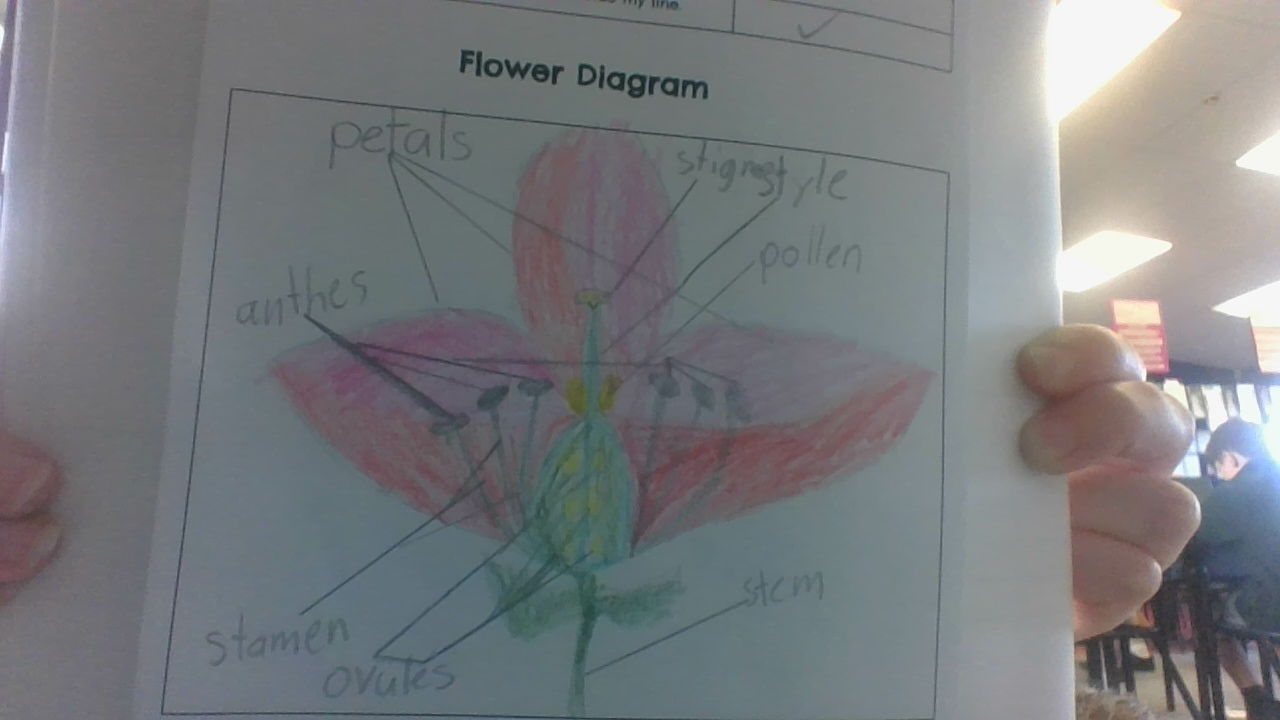
In my class we have been learning about pollination. We drew a picture of what is in a flower that helps with pollination. When the bees go from one flower to another they give pollen also known as cross pollination. The Ovules in the Ovary grow bigger and bigger until they turn into seeds and when the flower dies the Ovary swells up and (if it is a plum flower on a tree) it turns into a plum. There are so many parts in a flower that help pollination like:

  • Style
  • Anthers
  • Stem
  • Ovules
  • Petals
  • Stamen
  • Stigma
  • Ovary
These all have a part in pollination.